


Your text here.
Your caption here
Religious Education
Intent
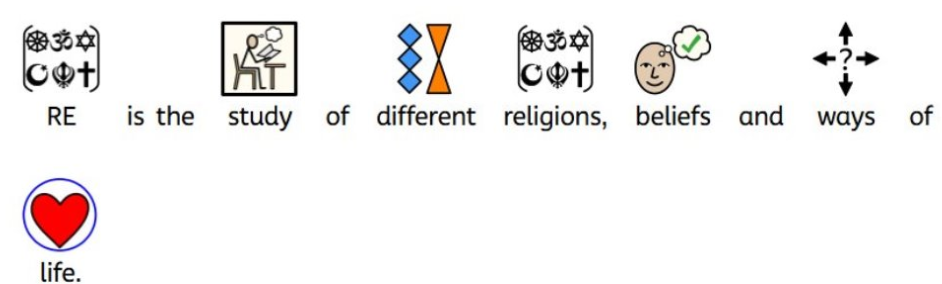
At Cotmanhay Junior School, we believe Religious Education helps children make sense of the diverse world around them and develop respect for people whose beliefs and experiences may be different from their own. Through the study of religion and worldviews, pupils explore questions about meaning, purpose, belief, identity and belonging whilst developing their spiritual, moral, social and cultural understanding.
Following the Derbyshire and Derby City Agreed Syllabus, pupils learn about Christianity, Islam, Hinduism, Judaism and Sikhism, alongside non-religious worldviews including Humanism. Through the strands of Believing, Expressing and Living, children develop knowledge of different faiths and worldviews whilst considering how beliefs influence the way people live.
Our curriculum is designed around enquiry-based learning. Through investigating Big Questions, pupils are encouraged to think deeply, ask thoughtful questions, challenge stereotypes and develop an understanding of diversity within modern Britain and the wider world. We aim for children to leave primary school as respectful, informed and reflective citizens who value equality and appreciate different perspectives
Implementation
Religious Education is taught through a progressive enquiry-based curriculum which follows the Derbyshire and Derby City Agreed Syllabus.
Each unit is structured around a Big Question. Children investigate four smaller enquiry questions which build knowledge and understanding before enabling them to answer the final enquiry question. This approach encourages curiosity, discussion, reflection and critical thinking.
Learning is organised through the three syllabus strands:
Believing
Religious beliefs, teachings and sources; questions about meaning, purpose and truth.
Expressing
Religious and spiritual forms of expression; questions about identity and diversity.
Living
Religious practices and ways of living; questions about values and commitments
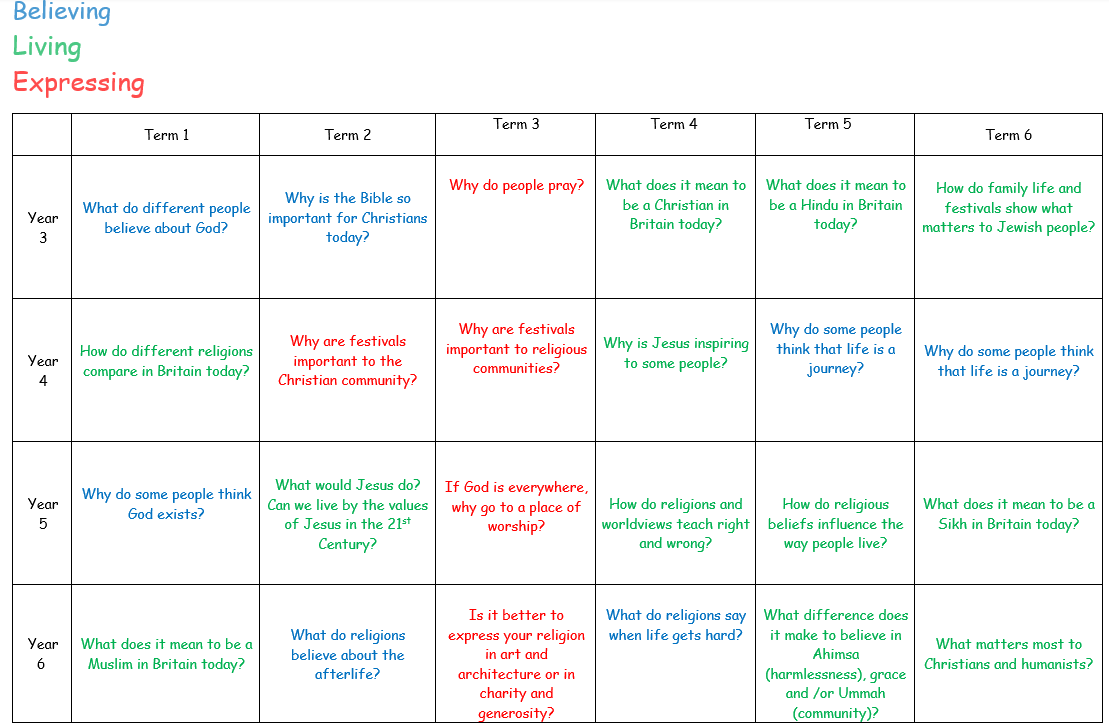 Our Religious Education curriculum follows a clear lesson structure that helps pupils build knowledge, develop understanding and explore important questions about religion and belief.
Each lesson begins with a 'Sticky Quiz', where pupils revisit prior learning and key vocabulary. This regular retrieval practice strengthens memory and helps pupils make connections across the curriculum.
During 'Learn It', new knowledge, concepts and religious teachings are introduced through stories, sacred texts, artefacts, images and discussion.
Pupils then move to 'Practise It', where they explore new learning through partner talk, sorting activities, role play and questioning. This provides opportunities to rehearse ideas and deepen understanding.
In 'Prove It', pupils demonstrate what they have learned, allowing teachers to assess understanding and address any misconceptions.
During 'Apply It', pupils use their knowledge to answer the lesson's enquiry question. They are encouraged to explain their thinking, draw upon religious beliefs and teachings, and justify their ideas using evidence from their learning.
Lessons end with 'Review It', where pupils reflect on key learning and consolidate their understanding through discussion.